There’s a moment that happens before the emails go out.
Before the announcements.
Before the carefully worded statements about “restructuring” and “strategic realignment.”
It’s quiet.
And in that quiet, everything gets really, really loud.
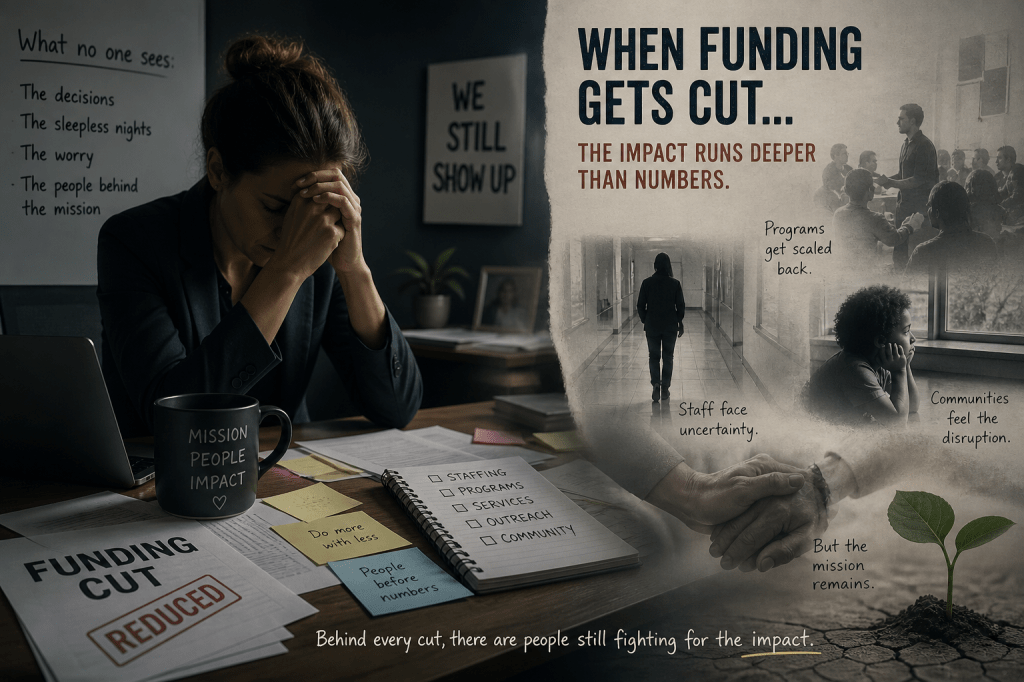
Because when funding gets cut, the impact isn’t just financial. It’s human. It’s operational. It’s emotional. And most of it… no one ever sees.
People see the headline: budget cuts.
What they don’t see is the unraveling that starts behind the scenes.
They don’t see leadership staring at spreadsheets that no longer make sense, trying to stretch dollars that are already gone. Trying to decide what stays and what goes when everything matters. When every program has a face. A name. A story.
Because this isn’t corporate excess getting trimmed.
This is impact being reduced.
No one sees the weight of deciding which services get scaled back.
Which communities get less.
Which students don’t get the same opportunity.
Which staff—people who have poured their heart into the mission—are now sitting on the other side of a decision they never saw coming.
And let’s be honest about something most people don’t say out loud:
There is no “good” way to do this.
You can be transparent.
You can be compassionate.
You can communicate early and often.
And it will still hurt.
What people don’t see is the internal conflict.
The battle between the mission and the math.
Because the mission says: serve more, do more, reach more.
But the math says: you can’t.
And when those two collide, leadership carries that collision long after the decisions are made.
They don’t see the ripple effect.
Programs slow down.
Innovation pauses.
Partnerships get strained.
Momentum—something that takes years to build—can shift in weeks.
And the hardest part?
You’re not just managing systems. You’re managing morale.
Because your team knows.
They feel it in the tension of meetings.
In the shift in priorities.
In the silence where there used to be excitement.
And even the strongest teams start asking questions no leader ever wants them to have to ask:
Am I next?
Is this stable?
Should I be looking elsewhere?
What people don’t see is how leadership absorbs it.
The sleepless nights trying to find a way through.
The constant recalculating.
The conversations behind closed doors that never make it to a public update.
And the pressure to still show up strong.
To still inspire.
To still lead with vision.
To still say, “We’re going to get through this.”
Even when you’re not fully sure how yet.
And then there’s the part that hits the deepest:
The people you serve.
Because they don’t care about funding cycles or appropriations or delayed grants.
They care about access.
Opportunity.
Consistency.
And when funding gets cut, what they experience is disruption.
A class that doesn’t start.
A service that’s no longer available.
A support system that suddenly looks different.
For organizations serving individuals already facing barriers, that disruption isn’t small.
It matters.
But here’s the part that rarely gets said—and needs to be.
Organizations don’t just collapse when funding gets cut.
They fight.
They get creative.
They restructure.
They rebuild in ways no one on the outside fully understands.
They learn how to do more with less—even when “less” feels impossible.
And the people inside those organizations?
They show up anyway.
Not because it’s easy.
Not because it’s stable.
But because the mission still matters.
Funding cuts don’t just test budgets.
They test leadership.
They test culture.
They test whether an organization was built on convenience… or conviction.
So the next time you hear that an organization lost funding, just know this:
The real story isn’t in the numbers.
It’s in the decisions no one wants to make.
The people no one wants to lose.
And the quiet resilience it takes to keep going anyway.
Because behind every funding cut…
there’s a group of people fighting to make sure the impact doesn’t disappear with it.
 staceybooks
Leave a comment